Tuesday, 28 February 2017
Note To Examiners
Welcome to my AS Media blog. Over the last 6 months we have created an institution, called Moral Panic Productions, and have produced a 2 minute film opening for a Horror film, that we have named Necro5is. I have shown the research, planning and production phases of this through my 101 blog posts. I hope you enjoy.

Saturday, 25 February 2017
Evaluation Question 7 : Progression from our Preliminary Task to our Final Product
7. Looking back
at your preliminary task (the continuity editing task), what do you feel you
have learnt in the progression from it to full product?
Looking back at our preliminary task, I think I have
progressed immensely in many different fields, especially camerawork and
editing. For the preliminary task, we recorded a short scene that aimed to show
different camera angles/movement, a short story and a usage of continuity
editing (where the editing follows what is happening in order). For our final
product, we had to produce a two-minute opening that conformed to all the stereotypes
and conventions of our chosen genre (horror) and demonstrated a wide variety of
camera and editing skills. Even from that, you can see where the improvements
will lie.
For our preliminary task, we used a couple of shots (making
sure that we met the brief for the task) but other than that did not really
branch out with the shots that we use. We greatly improved on this in our final
product. We researched a lot of movies, analysing the types of shots that they
used and the effect that they have – then transferred this to our actual
product. I produced a Test Footage post, that went over a variety of shots that
we wanted to use and explained what they were and the effect that they have on
the audience. In our final piece, I thought we used a good variety of shot, for
example; we used a birds-eye-shot from the drone, close-ups of people’s faces
during scenes where facial expressions needed to be shown, a low angle of the
killer and an over the shoulder shot of Basket-Case taking the pills. I feel
like our skills with the camera has also greatly improved, as we learned how to
manipulate ISO to our own liking and also how to experiment with different
focus points, for example shallow or deep focus. I think we have made a lot of
progress in this area since our Prelim, and can hopefully continue to improve
in the future.
Sound in our prelim was non-existent except from dialogue. This vastly changed in our final product, we went from using no non-diegetic sound at all to using it primarily. We added a backing track, sound effects, foley diegetic sound (like ambient woodland sounds) and we used high quality recordings of our dialogue and also our non-diegetic voiceover. The voiceover was used to explain the narrative more clearly and the backing track was used to show the genre and set the mood for the attached scenes. The comparison between our final product and the preliminary task is vast and shows an obvious growth of both skill and understanding, that was aided by research and target audience analysis (in the form of focus groups).
Another key thing that we needed to improve from our prelim
was the usage of the different aspects of Mise-En-Scene. In our prelim we didn’t
pay any attention to costume, lighting or facial expressions and body language.
We did include a prop, the briefcase, and an example of positioning (as in our
brief we were told we had to have two characters sitting across from one
another). In comparison, for our final product we had to focus on mise-en-scene
extensively, paying close attention to props, costume, make-up and hair,
lighting and positioning and setting. We decided on an iconic setting for
Horror movies, that being a forest, and as we decided on stereotypical
representations for each of the characters they all had attached costume and
make-up and hair pre-defined. Compared with the prelim’s single prop, our final
product contained an abundance of different items, from a butterly knife to a
pack of prescription pills to revision guides. Each one served a purpose in the
story much alike the one prop used in our prelim but each had to be thought
out. Positioning was also a key thing in our final product, and it was down to
our own choice as opposed to being forced into it by some kind of brief. Some
key examples were the worms eye view of Basket-Case’s foot that left space for
a title to be inserted, or the final scene where the sixth character is placed
in the right third of the frame, with the boggy swamp shown in the other
two-thirds of the frame (which established a setting of his capture). The
locations used in our final production also varied, despite being mostly set
around the woodland. We had the more open areas and the thicket of the wood,
each with a key reason why it had been used instead of anything else. This was
another improvement compared to our prelim as there we only used one location
that, whilst planned out, was not good as it was just in our school.
The final thing that was an extremely large improvement was
the editing from our prelim to our final product. In between we developed a lot
of key skills that allowed for the final product to look more professional and
to be more effective. In our prelim we used continuous editing, which followed
the current course of action, and just used cuts to transition between different
shots. We didn’t do anything else to the prelim, it was all raw footage spliced
and put together, mainly because we edited it on Windows Movie Maker which is a
very simple and featureless application. In comparison, our final product was
edited on Adobe Premiere Pro, which allowed a lot more customisation in our
editing. For example, we colour corrected almost every clip in order to
accentuate key shades, like deep greens, and also to lower the brightness in
order for our final product to conform more with the chosen genre (Horror).
Other editing techniques we used were strobing (flashing one image over
another) and using a black and white filter. We were also able to tamper with
the audio, changing different levels in order to produce a foley effect or able
to sync the backing track with what is happening on screen by looking at the
sound wave graphs. We taught ourselves a lot of the techniques used to edit in
this way by watching Youtube videos, which gave a visual tutorial on how to do
certain things. This allowed our library of techniques to be increased from our
prelim as we were constantly learning and trying out new things. This allowed
us to gain a furthered knowledge in the editing sector that can then be applied
to any products that we create in the future, hopefully with further progress
than this final product.
Tuesday, 21 February 2017
Evaluation Question 6 : Media Technologies
In the production of our opening two minutes of Necro5is, we used 3 different computer systems, those being a Windows laptop, Desktop and a Mac. The majority of the editing was done on the laptop due to its fast specs and accessibility/portability. However, the desktop did provide a system on which we could render the finished product fast, so that is where we did that. The Mac was used to compare the different editing softwares (which will be detailed later), but we decided that a Windows computer was more familiar and as a result decided to primarily use that. Also, we found that using a mouse made editing the product far easier, as it provided a better degree of accuracy than a trackpad could.
When filming the opening, we had to decide on what camera hardware we wanted to use. Since I personally own a DSLR camera (the Canon 700D) we decided to use that. This would be better than using the schools available cameras due to its variety of features, the opportunity of an interchangeable lens and the manual feature on the camera itself, that allowed us to change the ISO or light intensity of our recording, more towards our tastes. The DSLR also produced a higher quality of final image, making our finished product look very sleek and professional. The camera was digital, meaning that we could convert the footage straight into a format that could be interpreted by the computer and edited in our chosen software. There weren't many downsides to using the DSLR, other than its size and the fact that at one point it did run out of battery during a shoot.
When filming we decided to use the Rode Videomic in order to record high quality audio for our film. This replaced the poor quality of the camera, which was quite echoed and buzzy. The mic allowed us to capture ambient sound or dialogue, both features we used in our final production. The downside of using the mic was that we had to purchase batteries as it burns through them quickly and it also provided some problems with not having turned it on and as a result having to reshoot some scenes, which in hindsight didn't matter as the majority of our opening has the dialogue muted anyway.
In order to set our product apart from other texts, we chose to include drone shots. These were filmed on the DJI Phantom 4 drone, which is one of the best drones on the market (for the average consumer at least). We borrowed this off of a family member of one of the group, who also flew it for us (to make sure we did not crash it!). Using the drone allowed us to get birds-eye-view shots of our setting, the forest, in extremely high quality (4K). These shots added a sense of prestige to our opening, as it is not something that is often seen. The disadvantages of using it were the time it consumed in order to prepare it and get it into flight, alongside the fact that it is very expensive and as a result required a great deal of care whilst in use. Despite this. I would definitely like to use it for future productions.
In regards to editing software, we sampled three different programs before concluding to use Adobe Premiere Pro CS6. We came to this choice because it was the most effective to use, containing lots of different features and a dedicated, detailed timeline and also because it could be used on Windows computers (unlike iMovie, which is only on apple products). Premiere Pro has the ability to change a clip's opacity, volume and motion (placement and zoom on the screen). Changing something like the opacity allowed us to create a strobing effect, used to tease the sixth character throughout the clip. Alongside this, it has over one hundred built in effect pre-sets, for example a warp effect or a black and white effect (both of which we used in our finished product). Also, Premiere Pro provides a lot of colour correction options, that of which we used extensively on almost every single clip in our work in order to colour grade it so that it fit our genre more clearly. It also allowed our 4K drone files to be handled, despite having a lot of frame-rate lag before we rendered the project (which is due to the computers specifications, not the software). The other programs we used were Movie Maker (for our prelim), iMovie (for our first draft) and Final Cut Pro just to test it out. The former two were just too simple to work for the final product and also did not contain enough options to change the clips how we wanted. The final program was good and had a abundance of features but is not available on Windows, so we didn't use it.
Finally, I wanted to cover all of the different web-pages I used in order to construct my blog and present my research, pre-production and post-production elements. The blogging site I used was blogger, mainly due to its ease of use and newbie accessibility. I used a wide-variety of web 2.0 tools to present my work, including; powtoon, prezi, emaze and coggle. Powtoon is a tool that allows you to create animated cartoons in order to present information. Prezi is a presentation tool that adds more movement to presentations, following a set path instead of a slide by slide layout. Emaze is your normal presentation software but is free and online. Coggle is a mind mapping site, an example of which is above. All of the web 2.0 tools aided my understanding of different topics because they put it into a more interactive and interesting format than just bland blog posts.
Thursday, 16 February 2017

Sunday, 12 February 2017
Wednesday, 8 February 2017
Saturday, 4 February 2017
Wednesday, 1 February 2017
Evaluation Question 1 : Forms and Conventions
1. In what ways
does your media product use, develop or challenge forms and conventions of real
media products?


- From left to right, top to bottom - The title of the film, Setting/location, Costumes and props,
Camerawork and editing, Title font and style, Story and how the opening sets it up,
Genre and how the opening suggests
it, how characters are
introduced, Special effects
The title of our film is Necro5is. The ideologies
behind this was that we wanted to find a synonym of the word death but also be
able to incorporate a number (5) into the name itself, much in the same way as
the movie Se7en does. This is because the number five is a key topic in our
film, with their being five friends. However, this also acts as somewhat of a
red-herring, as we actually have six characters, the last of which is revealed
at the end of the two-minute opening. Our film title uses the common movie
convention of having a title that, whilst fitting the movie in one way or
another, does not reveal too much about the overarching story. Despite this, we
also challenged the common conventions by adding the number into the name,
something that has only been done by the vast minority of films. This blending
of common and rare conventions makes the final product of the film stand out to
not only our target audience but also a wider audience coaxed in by the
ambiguity of the title.
 |
| Title from Se7en, which we took inspiration from |
The setting for our film is the forest at Thorndon
Country Park. This is a very conventional location for the horror genre, due to
its connotations of darkness and isolation and also its direct linking to
common phobias like Nyctophobia (fear of the dark) and Mazeophobia (fear of
being lost). A lot of movies use this setting for good effect, such as Camp
Crystal Lake from any of the Friday the 13th films, Deadite Forest
from The Evil Dead and Black Hills Forest from The Blair Witch Project.
The woodlands in these films present the ideas of the unknown, each of which
containing mysteries that need to be discovered. As we took our inspiration
from The Breakfast Club, but produced a movie from the horror genre, we decided
to take these character archetypes out of the setting of that film and place it
in the setting from a film with the same kind of casting, like The Blair Witch
Project. Whilst doing this, the characters are the main focus as opposed to cheap
scares – which challenges the norm for Horror flicks of this category.
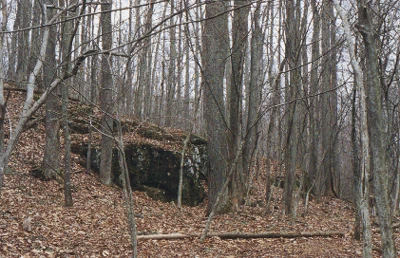 |
| Black Hills Forest, setting of The Blair Witch Project, which was our inspiration for Thorndon Country Park |
The costumes that we used in our opening two
minutes follow the conventions of this genre of movie very closely. Each of
them link to the character archetype that is being used for our two minutes;
the Basket-Case wears black clothing with ripped jeans, the Princess wears a
sexually revealing dress, the Jock wears sport related clothing (like a
baseball cap), the Brain is dressed smartly and finally the Criminal wears a
coat with the hood up. An easy comparison to draw here is to our main
inspiration, The Breakfast Club; which we followed but also adapted to fit our
modern day story. Another comparison is between Basket-Case and the main
character from the remake of Evil Dead, as both of them wear clothes often
associated with ‘emo’ or ‘gothic’ individuals. Another aspect which we chose
not to challenge the conventions of was props. For our props we used
stereotypical items that could be found in everyday life and our audience could
relate to having; i.e. a butterfly knife, some prescription pills and school
revision guides. We also included a mobile telephone as a prop that shows that
our movie is set in a very modern time- as the phone shown is a recent release.
These types of props can also be seen in modern day horror movies like The
Forest, where the main character is often seen holding a mobile phone.
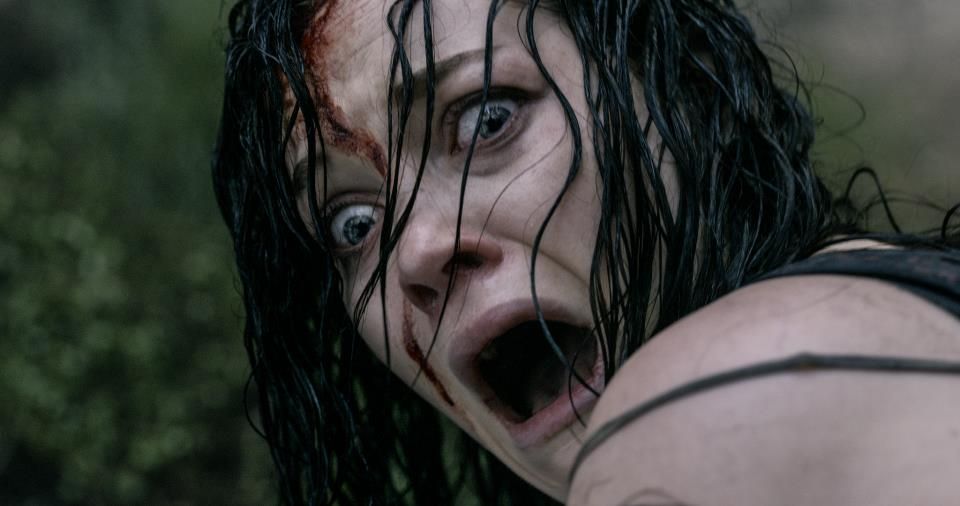 |
| Main character from Evil Dead, providing a comparison to Basket-Case |
Every cinematic media text uses a wide variety of
camera angles, movement and editing techniques in order to add variety to their
product- but camerawork can also convey hidden messages (like emotions) from
what is happening on screen. For our two-minute opening, we used a multitude of
different techniques in order to convey our story through camerawork. For
example, we used a close-up of a character's face at the end in order to show
the emotion of terror, much akin to the close-up shot that is used in the movie
psycho. We also used a close-up of Basket-Case’s face when she is shouting, to
show her anger and how she is distraught about the situation. We used some
extreme long shots in order to establish the woodland scenes, at one point
using a panning shot to show a path with the light shining between the trees.
Another key shot that we took was the birds-eye-view from the drone. This shot
created an enigmatic quality, showing that our setting could be anywhere in the
world as there was no key iconography (like recognisable buildings). It also
showed the vastness of our setting, again tending to the idea of isolation.
This shot challenged stereotypes for this genre, as it isn’t a shot you would
normally see in a horror movie due to the expenses of filming the shot itself.
For editing, we mostly used fades to transition between scenes because of their
more calming nature (as our opening scenes is mostly not action-filled).
However, during the killing scene and the scene at the end we used fast-paced
clear cuts, in order to progress the scene at a fast rate which would increase
the tension shown. Some of the other editing techniques we used were; colour
correction to change the grading of the shots (warping them to the mood they
needed to set), overlays (where one scene will be shown over another at a lower
opacity- hiding something within the scene) and strobing, where a scene will
flash quickly in a disorientating fashion.
 |
| Mid-Shot of Basket-Case detailing body language and facial expression |
For our titles we chose to use the font 1942 report
due to the fact that it fits with both our genre and our subject matter. This
is because it has a kind of glitchy effect built into the font (where part of
the word is repeated just at a different angle). We presented the titles in
different sizes and at different points inside the frame. For example, when our
company name is shown (after the intro) it is directly in the middle over the
top of the drone shots. The reason we chose to do this is because we took
inspiration from The Shining’s Opening. Sizes are also an important aspect, for
example the Director and Assistant Director titles are very large, with the
latter slightly smaller, compared to the other crew. Also, for the actor name,
their first name is small whilst the second name is bigger (as the last name is
what people would be searching for (for example DiCaprio). We made this
decision based on research on the site Art of the Title, which details title
sequences from lots of movies, where we saw that this is a convention of almost
every film. The title positioning that we chose aimed to blend the titles into
the scenes themselves, in an attempt to not have them stick out too much from
what is happening on screen. As a result, we had the titles ‘interact’ with the
scene itself, for example when Basket-Case steps on her actress’s name
(Charlotte Johnson), it disappears. This challenges the convention of having
the name just ‘be there’ as opposed to being co-ordinated within the scene
itself.
 |
| Opening Credits to The Shining, which we consulted for aid on positioning our titles |
The story of our film, from the opening 2 minutes
at least, is extremely ambiguous. The audience will be introduced to the five
key characters, and will also constantly see flashes of another sixth character
who is revealed at the end of the two minutes. This character seems to be the
main character as this is who is speaking during the voiceover. As we removed
most of the audio, the only way that the story is shown is through the visuals
that are used, and through the aforementioned voiceover. Most Horror (and
Thriller) movies start off in a very ambiguous format, the idea is to build the
mystery and intrigue throughout the film, instead of having it revealed in the
opening 2 minutes. For example, in the movie Scream, we are introduced to a
character who, five minutes later, is then brutally murdered by a masked
killer. This arises questions for the viewer and entices them to continue
watching- a technique we used here by also having a killing scene (that
featured a masked murderer) and by having the reveal of the sixth character at
the end. This leads to the audience wanting to find out what is happening, as
to find out who these people are and what their motives are.
 |
| Opening of Scream, providing a comparison of the way in which characters are introduced |
The genre for our film is Horror, but during
production it also lent towards having thriller elements spliced in (for
example the mystery themes). The way we decided to show the genre is through
two key aspects, the lighting and the soundtrack. The soundtrack is intense and
eerie, aiming to make the audience feel uncomfortable. We used Foley sounds
with the screams that startle Brain, which we later associate with the sixth
character, in order to also startle the audience. The lighting (and by
extension the colour grading) of each scene was chosen in order to make the
scenes look darker and more brooding (low-key), compared to the high-key
lighting they were shot in (as it was mostly daytime filming). Some of the
camera shots that we used also reflect the genre, especially the two Point of
View shots (first of which being the feet running and the second being just
running through the woodland). These types of shots are commonly used in films
like The Blair Witch Project which, as it is a found-footage film, is mostly
made up of POV shots. These connoted the idea of being chased by someone and of
running in fear, which is the feeling that we wanted to portray to the
audience. Finally, despite it not being extremely obvious, we did use
fake-blood during the killing scene, that of which splashes up onto the
killer’s mask and over his weapon (which is shown flickering in an overlay,
dripping with blood). This usage of gore is a key convention of a horror movie
but in hindsight we could have shown it in both more detail and for a longer
period of time.
 |
| Flickering of Hammer, showing the Horror genre through gore |
In most horror movies, taking the Evil Dead remake
as an example, the main set of characters are not introduced until after the
introduction of the film. In the Evil Dead remake, there is a whole exorcism
scene that takes place before we even see the first of the characters that are
followed through the rest of the movie. We decided this was not a good strategy
and decided to challenge this by introducing our characters early, however we
did have a sort of introduction beforehand (the opening credits, the killing
scene and the film title). Also, in a movie like the original Evil Dead, the characters are
introduced one by one, a convention which we decided to pretty much follow, bar
Jock and Princess who are obviously in a relationship and as such should have
been introduced together (even though we see Princess first). But, in
comparison to our opening, the characters are focused on for a longer period of
time before another is introduced, where as ours are pretty much glanced over. So,
despite us challenging this trope, I think that we could have spent more time
focusing on some of the characters (like Criminal), but could not due to the
two-minute time limit.
 |
| Original Evil Dead characters |
Our two-minute film opening did not contain that
many special effects, as we did not have money to spend and also did not have
the ability to create amazing CGI or visual effects like in blockbuster films.
However, there are some movies that take this approach, such as 30 Days of
Night, that focuses mostly on practical effects in its horror, to add that
sense of realism. We put an effect on the voice-over in order for it to sound
somewhat distorted, like when someone does not want their identity to be
revealed on something like the news or in an interview. This adds another sense
of mystery as the audience does not know why the voice is aiming to be
concealed. Other than that, special effects were not common in our opening,
other than colour-correction, changing some scenes to black and white (to
represent a flashback)- like in one episode of The Walking Dead, and adding
filters over said scenes to make then glitch/stutter/strobe, in order to
increase uneasiness.
 |
| Black and White Walking Dead Flashback |
In conclusion, I feel like our finished product
blended a lot of already in use conventions and techniques with some genre
challenging and fresh ideas, in order to create an individual piece of
cinematography. We took inspiration from many horror films, and some that were
not, and changed some of their conventions to fit our ideas (like converting
the character archetypes of The Breakfast Club to modern day, or using similar
camera shots to The Blair Witch Project). I think that researching into
conventions helped us produce a better final product, especially in aspects
like titling, and also expanded our media knowledge in this field.
Subscribe to:
Comments (Atom)